
FAA 2010 Lecture: Introduction to Solar Revolutions
$14.99
This short lecture introduces several solar revolution techniques, part of the Persian suite of annual predictive techniques: profections, the solar revolution chart, and transits. Length 1:08:57, 31MB.
You may also like…
Workshop: Elements of Solar Revolutions
This 2.5-hour workshop shows in great detail how to understand and combine several traditional techniques for analyzing a native's chart from year to year, using solar revolutions (solar returns), profections, and the direction of the Ascendant of the solar revolution. Length 2:34:55, 71MB.
Persian Nativities III: On Solar Revolutions
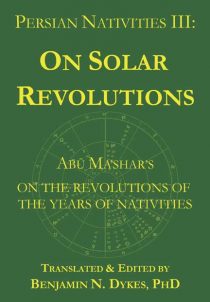
This third volume of the Persian Nativities series is a translation of the surviving Latin version of Abu Ma’shar’s On the Revolutions of the Years of Nativities. It covers all of the primary predictive techniques: profections, solar revolutions, distributions, transits, and firdaria.
Related Products
Two Special Configurations: Aversion and Decimation
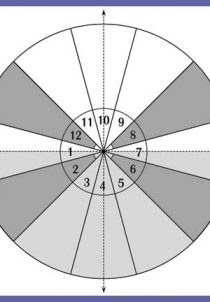
This downloadable audio lecture describes two important configurations in traditional astrology, illustrating them with chart examples. See longer description below. Contains MP3 audio, slides, and a handout. (Length: 1:12:00, 33MB.)
Hermann of Carinthia: The Search of the Heart
“Every question of astronomy… is either in thought or in speech.”
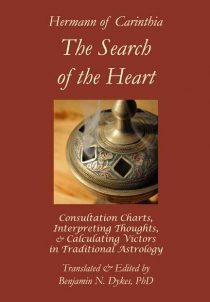
In the 1140s AD, Hermann of Carinthia assembled instructions from medieval Arabic-speaking authorities on interpreting the unstated thoughts of clients (now called “consultation charts”), often using a “victor” or mubtazz or almuten for topics or the chart. Hermann also offered his own reflections on the proper balancing of dignities, house rank, and planetary strength.
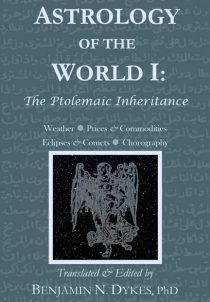
Astrology of the World I: The Ptolemaic Inheritance
Astrology of the World I: The Ptolemaic Inheritance presents numerous selections by Arabic and Latin authors on areas of mundane astrology inspired by Ptolemy’s Tetrabiblos. Many texts have been translated directly from Arabic by Benjamin Dykes. Authors include al-Kindi, ‘Umar al-Tabari, al-Rijal, Masha’allah, Abu Ma’shar, ibn Labban, Dorotheus, and ibn Ezra.

FAA 2010 Interview: Translating the Tradition
In this interview by Brian Clark, Dr. Dykes explains a bit about his background, what is important about traditional astrology, and its future. Length 38:10, 17MB. $4.99

Life Purpose and Spirituality in Traditional Astrology
This lecture introduces three basic techniques for looking at a native’s sense of purpose and spirituality: personal happiness or prime motivation, religion or law, and the Victor of the chart (sometimes called the mubtazz or almuten) Length 1:11:55, 33MB.
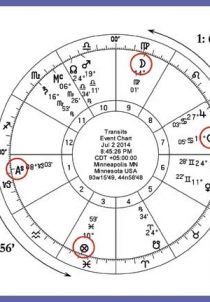
A Traditional Approach to Lots
This workshop presents rules and numerous example charts for 6 Lots (“Arabic Parts”) useful in natal interpretation: the Lots of the father, mother, children, marriage, friends, and work/action. No previous knowledge of Lots or allegiance to traditional methods is assumed. See longer description below. Contains: MP3 and slides. Length: 2:50:00, 78MB.
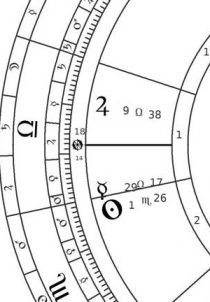
Workshop: Distributions Through the Bounds
This special, hands-on workshop will teach you how to use “distributions,” an ancient and powerful predictive technique, in both natal and solar return charts. Length 3:03:00, 84MB.
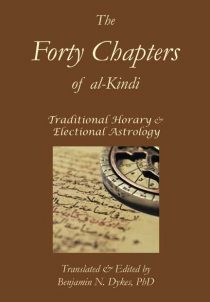
The Forty Chapters of al-Kindi
The famous, “first” Arab philosopher, al-Kindi (ca. 801-870 AD) wrote many instructional letters and works on astrology and the universe. The Forty Chapters is on horary and electional astrology: answering questions and choosing auspicious times to act. It is the second volume in the horary trilogy, preceded by The Search of the Heart and followed by The Book of the Nine Judges.