
Saturn in Traditional Mundane Astrology
$20.00
This special lecture for RubiCon Astrology looks at the role of Saturn in traditional mundane astrology, beginning with Abu Ma’shar’s planetary hierarchy and Saturn’s role as the king and lawgiver, then moving to Saturn-Jupiter mean conjunctions, transits of and/or to Saturn, and Saturn-Mars conjunctions in Cancer. Approx. 1 hour, with audio and slides. $20
Please use your regional Amazon location for best shipping price!
You may also like…
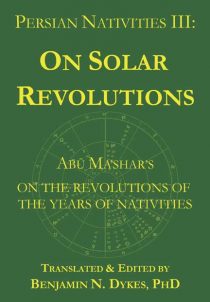
Persian Nativities III: On Solar Revolutions
This third volume of the Persian Nativities series is a translation of the surviving Latin version of Abu Ma’shar’s On the Revolutions of the Years of Nativities. It covers all of the primary predictive techniques: profections, solar revolutions, distributions, transits, and firdaria.

Workshop: Elements of Solar Revolutions
This 2.5-hour workshop shows in great detail how to understand and combine several traditional techniques for analyzing a native's chart from year to year, using solar revolutions (solar returns), profections, and the direction of the Ascendant of the solar revolution. Length 2:34:55, 71MB.
Related Products
Primary Directions Without Tears
This audio download discusses how primary directions differ from other techniques like progressions, and completely explains how to calculate traditional directions using your astrology program’s animation function, illustrated with several chart example. Contains: MP3 and slides. Length: 1:45:00, 49MB.

Signs and Houses – AFA 2011 Lecture
This lecture from the highly successful AFA 2011 Conference in Arizona combines material on signs, dignities, house classifications, aversions, and interpretation. Much of this will be new to purchasers of other lectures, but it is valuable to beginners in traditional astrology. Length 1:15:00, 36MB.

FAA 2010 Lecture: Introduction to Solar Revolutions
This short lecture introduces several solar revolution techniques, part of the Persian suite of annual predictive techniques: profections, the solar revolution chart, and transits. Length 1:08:57, 31MB.

Victors, Almutens, and the Holy Guardian Angel
This audio download explains the concept of victors or “almutens” in traditional astrology: how to calculate and understand several types, and how to use Renaissance methods to determine the planetary category and name of one’s personal Angel or Higher Genius. See longer description below. Contains: MP3 and slides. (Length: 2:53:00, 83MB.)

FAA 2010 Workshop: Special topics
This advanced workshop takes a tour through five special topics in traditional delineation and prediction: detriment and fall, aversion, bounds, stakes/angles and overcoming, and profession. Total length: 3:32:51, 48MB.

Life Purpose and Spirituality in Traditional Astrology
This lecture introduces three basic techniques for looking at a native’s sense of purpose and spirituality: personal happiness or prime motivation, religion or law, and the Victor of the chart (sometimes called the mubtazz or almuten) Length 1:11:55, 33MB.
Introduction to Traditional Mundane Part 1
This presentation introduces traditional mundane astrology, beginning with Ptolemy’s method for interpreting and timing eclipses, prices and weather, and historical astrology: framing history into larger and smaller periods, especially using Saturn-Jupiter conjunctions. Length 1:16:09, 36MB.

Two Special Configurations: Aversion and Decimation
This downloadable audio lecture describes two important configurations in traditional astrology, illustrating them with chart examples. See longer description below. Contains MP3 audio, slides, and a handout. (Length: 1:12:00, 33MB.)