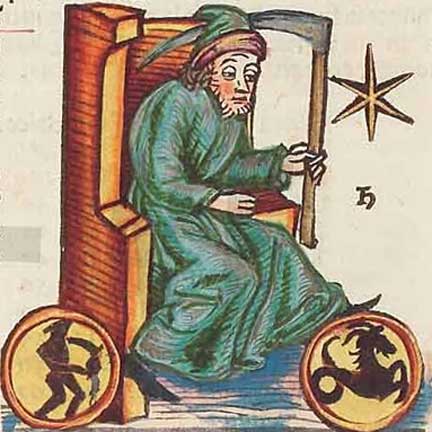
Saturn in Traditional Mundane Astrology
$20.00
This special lecture for RubiCon Astrology looks at the role of Saturn in traditional mundane astrology, beginning with Abu Ma’shar’s planetary hierarchy and Saturn’s role as the king and lawgiver, then moving to Saturn-Jupiter mean conjunctions, transits of and/or to Saturn, and Saturn-Mars conjunctions in Cancer. Approx. 1 hour, with audio and slides. $20
Please use your regional Amazon location for best shipping price!
You may also like…
Workshop: Elements of Solar Revolutions
This 2.5-hour workshop shows in great detail how to understand and combine several traditional techniques for analyzing a native's chart from year to year, using solar revolutions (solar returns), profections, and the direction of the Ascendant of the solar revolution. Length 2:34:55, 71MB.
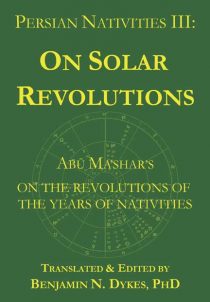
Persian Nativities III: On Solar Revolutions
This third volume of the Persian Nativities series is a translation of the surviving Latin version of Abu Ma’shar’s On the Revolutions of the Years of Nativities. It covers all of the primary predictive techniques: profections, solar revolutions, distributions, transits, and firdaria.
Related Products
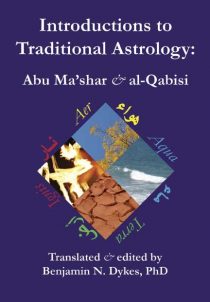
Introductions to Traditional Astrology: Abu Ma’shar & al-Qabisi
Introductions to Traditional Astrology (ITA) is a joint translation of two classic introductory works: Abu Ma’shar’s Abbreviation of the Introduction to Astrology, and al-Qabisi’s Introduction to Astrology. It also includes numerous passages from Abu Ma’shar’s Great Introduction (never before published in English) and other medieval astrologers on interpretating traditional concepts. (425 pages)
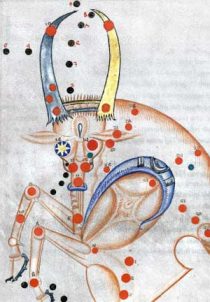
Introduction to Traditional Astrology
This lecture covers eight major differences in technique, attitude, and approach which distinguish traditional astrology from modern types. (Length 38:20, 18MB).
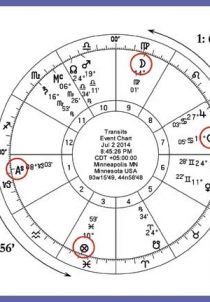
A Traditional Approach to Lots
This workshop presents rules and numerous example charts for 6 Lots (“Arabic Parts”) useful in natal interpretation: the Lots of the father, mother, children, marriage, friends, and work/action. No previous knowledge of Lots or allegiance to traditional methods is assumed. See longer description below. Contains: MP3 and slides. Length: 2:50:00, 78MB.
Hermann of Carinthia: The Search of the Heart
“Every question of astronomy… is either in thought or in speech.”
In the 1140s AD, Hermann of Carinthia assembled instructions from medieval Arabic-speaking authorities on interpreting the unstated thoughts of clients (now called “consultation charts”), often using a “victor” or mubtazz or almuten for topics or the chart. Hermann also offered his own reflections on the proper balancing of dignities, house rank, and planetary strength.

Victors, Almutens, and the Holy Guardian Angel
This audio download explains the concept of victors or “almutens” in traditional astrology: how to calculate and understand several types, and how to use Renaissance methods to determine the planetary category and name of one’s personal Angel or Higher Genius. See longer description below. Contains: MP3 and slides. (Length: 2:53:00, 83MB.)
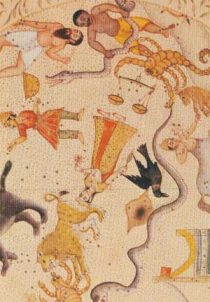
Signs and Houses – AFA 2011 Lecture
This lecture from the highly successful AFA 2011 Conference in Arizona combines material on signs, dignities, house classifications, aversions, and interpretation. Much of this will be new to purchasers of other lectures, but it is valuable to beginners in traditional astrology. Length 1:15:00, 36MB.
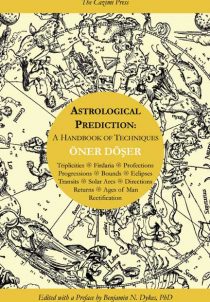
Astrological Prediction: A Handbook of Techniques
This new work by popular Turkish astrologer Öner Döşer embodies an important new trend in astrology: the harmonizing of traditional and modern techniques for contemporary astrologers. The traditional techniques here include: Ptolemy’s Ages of Man, triplicity periods, distributions or directions through the bounds, primary directions, profections, and firdaria. Contemporary techniques include secondary progressions, solar arcs, and transits. Click here for a PDF excerpt.

Ascensional Times: Theory and Practice
This lecture explains the meaning and uses of ascensional times (measuring how fast the signs rise), from their philosophical meaning to their use in elections, map-making and climes, distributions (a kind of primary direction), judging sect in a chart, personality types across the world, symbolic predictions with triplicity lords of the sect light, and calculating solar return Ascendants.The download includes PDF slides and a handout. Length 1:13:31, 48MB.