
FAA 2010 Lecture: Introduction to Solar Revolutions
$14.99
This short lecture introduces several solar revolution techniques, part of the Persian suite of annual predictive techniques: profections, the solar revolution chart, and transits. Length 1:08:57, 31MB.
You may also like…
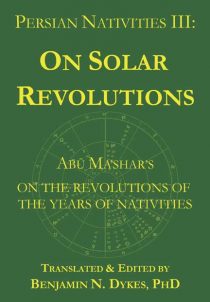
Persian Nativities III: On Solar Revolutions
This third volume of the Persian Nativities series is a translation of the surviving Latin version of Abu Ma’shar’s On the Revolutions of the Years of Nativities. It covers all of the primary predictive techniques: profections, solar revolutions, distributions, transits, and firdaria.
Workshop: Elements of Solar Revolutions
This 2.5-hour workshop shows in great detail how to understand and combine several traditional techniques for analyzing a native's chart from year to year, using solar revolutions (solar returns), profections, and the direction of the Ascendant of the solar revolution. Length 2:34:55, 71MB.
Related Products
Introduction to Traditional Mundane Part 1
This presentation introduces traditional mundane astrology, beginning with Ptolemy’s method for interpreting and timing eclipses, prices and weather, and historical astrology: framing history into larger and smaller periods, especially using Saturn-Jupiter conjunctions. Length 1:16:09, 36MB.

FAA 2010: Relationships and sexuality
This lecture introduces traditional techniques for delineating sexuality and relationships in the chart, from the 7th house to Venus, to predictive techniques using the Lot of Marriage. Length 1:15:46, 35MB.

Saturn in Traditional Mundane Astrology
This special lecture for RubiCon Astrology looks at the role of Saturn in traditional mundane astrology, beginning with Abu Ma’shar’s planetary hierarchy and Saturn’s role as the king and lawgiver, then moving to Saturn-Jupiter mean conjunctions, transits of and/or to Saturn, and Saturn-Mars conjunctions in Cancer. Approx. 1 hour, with audio and slides. $20
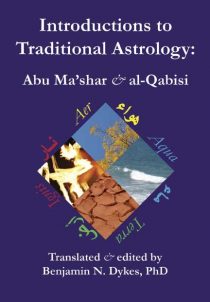
Introductions to Traditional Astrology: Abu Ma’shar & al-Qabisi
Introductions to Traditional Astrology (ITA) is a joint translation of two classic introductory works: Abu Ma’shar’s Abbreviation of the Introduction to Astrology, and al-Qabisi’s Introduction to Astrology. It also includes numerous passages from Abu Ma’shar’s Great Introduction (never before published in English) and other medieval astrologers on interpretating traditional concepts. (425 pages)
FAA 2010 Workshop: Special topics
This advanced workshop takes a tour through five special topics in traditional delineation and prediction: detriment and fall, aversion, bounds, stakes/angles and overcoming, and profession. Total length: 3:32:51, 48MB.

Freedom, Ethics, Metaphysics: Philosophical Issues in Traditional Astrology
This lecture explores several views on what astrology is, what the universe could be like, and freedom of the will and determinism. Length 1:21:00, 37MB.
AFA 2011 Traditional Astrology Conference
In September 2011, the oldest American astrological association, the American Federation of Astrologers, hosted a three-day traditional astrology conference. Held in honor of James Holden's research into and historic translations of traditional texts, Benjamin Dykes, Demetra George, and Chris Brennan gave extensive presentations on numerous traditional concepts and techniques. Running at 13 hours of audio (375 MB), this audio download contains MP3 recordings of the proceedings, plus many PDF slides and study aids. See list of lectures below.

Ascensional Times: Theory and Practice
This lecture explains the meaning and uses of ascensional times (measuring how fast the signs rise), from their philosophical meaning to their use in elections, map-making and climes, distributions (a kind of primary direction), judging sect in a chart, personality types across the world, symbolic predictions with triplicity lords of the sect light, and calculating solar return Ascendants.The download includes PDF slides and a handout. Length 1:13:31, 48MB.